Many people design their homes with a future buyer in mind. They choose neutrals whether or not they like them. Yes, it is safe. It might not offend anyone. They live cautiously, as if tenants in their own homes.
As a first-time homebuyer, I made different decisions. I chose to decorate our home. I did not ‘stage’ it. I did not neutralize it. I decorated it to our taste and expectations. It was not expensive, simply lovely.
I was warned repeatedly. “Nobody will buy this when you want to sell.” ‘They’ were wrong. Not only did my homes sell, they sold quickly and for top values. Even when two of my two-story foyer walls were enameled in hunter green.
Why? Because a home that has been lived in fully carries something no neutral palette can replicate. It has presence. It has coherence. It has conviction. Buyers do not respond to emptiness. They respond to authenticity.
Endless expanses of neutrals might offend no one, but they inspire no one either. They exist in a kind of suspended neutrality, waiting for permission to become something else.
A decorated home, one that has been lived in and cared for, offers evidence of permanence. It shows that the structure was worthy of investment, it was worthy not only financially, but emotionally. It shows that someone trusted the home enough to inhabit it fully. That trust has value.
A home must feel permanent and anchored. It should not feel disposable. It should neither be assembled from materials designed for replacement, nor lived in cautiously for the sake of resale. It should be inhabited fully, honestly, and without apology.
Raising children on ‘nice’ furniture and flooring helps them know that they are trusted and valued. Pets can be trained to respect property. Do not relinquish your life and time to “children and pets” at the expense of quality and permanence. Even if an item sustains damage, that damage carries a history of time and place. It will bring wistful memories when there is peace and order in the house.
I encourage my clients to buy the nice furniture while their children are young. Let them inhabit a home, not just a ‘playhouse.’ Help them understand value, boundaries. Help them learn care and consideration. That is a priceless education.
Choose what you love and it will endure.
Live where you are.
When the time comes, the market will recognize the difference.
It is the Holiday Season again. Social calendars and children’s activities are at their peak. A common belief is that December is “quiet” in real estate. In reality, things are abuzz preparing for the New Year. Realtors are planning and wrapping up their year. Many homeowners are thinking, while perhaps, not taking immediate action.
When the calendar slows, distractions abound. Plans percolate. There might be fewer sales. There is also less competition (good for buyers). Are you evaluating how your space functions? Conversations often shift from “Should we?” to “What do we want next?” What do you really want?
The Conversations That Matter Most
Planning conversations revolve around timing, readiness, and sequencing. Much depends on selling or holding the current property. Should you consider a more immediate or deferred approach?
What matters to you most? Do you need more space, a different location, more land? What does your next chapter look like?
Here is why early planning matters. Several years ago, a client shared some plans for the following year. We discussed options and made a plan. I received a distress call shortly before their listing was going on the market. A neighbor was also going on the market at the same time. “What should we do?” I assured them that we are ready to put the house on the market immediately. There were no properties for sale in the entire community. So, “Let’s get you several offers, the best buyer, and the best offer, and those who miss your house can have the next one.” This is exactly what happened. Soon after their sale, three more houses came on the market. There were no multiple offers. Our price remained top for the neighborhood for quite some time.
Financial Considerations
The financial and strategic conversations are inescapable – the “yes…but.” Yet, where there is a will there is a way. You most likely have equity in your current property which will benefit your future purchase. As a seller, tax advantages could help you act sooner than later. Perhaps now is a good time to have a preliminary conversation with your trusted real estate advisor.
Your three percent loan is marvelous, but you can still up or downsize despite interest rate fluctuations. I have structured many happy outcomes and helped my clients build wealth.
Waiting until January or worse, “spring” limits your options. January brings speed, competition, and many external pressures. Making reactive decisions is rarely optimal. Early conversations allow for better evaluation, preparation, and ultimately, execution.
As in any important financial consideration, thoughtful outcomes begin with thoughtful conversations. If you are considering a potential change, contact me now. I will help you sort the pieces and give you meaningful information with which to make good decisions. After all, the best real estate decisions are rarely rushed. They are considered.
After attending the Loudoun County Chamber of Commerce ‘PolicyMaker Series: Postelection Aftermath’ I walked away with concerns and considerations. This blog is not intended to make or take a political stand, but to outline possibilities and current actions. Keeping you informed so that you can make the best possible decisions, is always my goal.
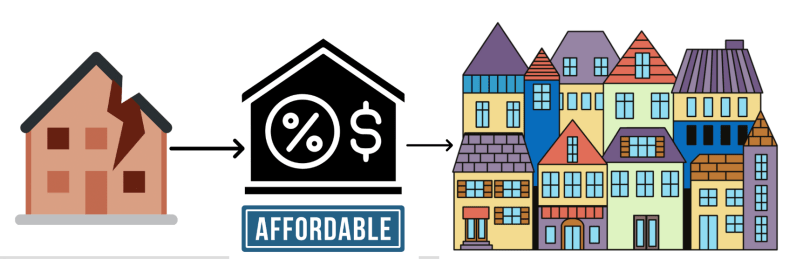
Politicians and analysts banter the term, affordable housing. Let’s unpack this concept and discover how, if at all, affordability can be affected.
The variables of affordability consist of the following obvious pieces:
The price of real estate
The mortgage interest rate
The mortgage term (number of years)
Cost to insure
Taxes
Income tax incentives (if any)
Housing supply and local zoning
To improve affordability, one or more of the above variables must be influenced as follows:
Private property values are subject to market forces.
Mortgage interest rates while variable, can be subsidized by jurisdictions or offset by tax savings
The term of the mortgage 15-30-50 affects the monthly payment
Insurance is partly environmental risk based, and partly determined by your desired value to insure and what to include.
Taxes – real estate taxes are based on jurisdictional assessments. You can appeal assessments. You can elect officials who would reduce tax rates.
The Federal government or even the state can make interest, taxes, etc. deductible at higher rates – AKA – subsidizing through deductibility.
Supply and demand shifts from scarcity to accessibility can partially be accomplished through thoughtful zoning and maybe expeditious reviews.
Below are possible solutions but will require bold federal and state participation.
Let’s clear one thing up – homeowners do not plan to decrease the asking prices for their houses in a scarcity scenario. Insurers have suffered massive losses and will likely not be reducing their rates, and their reinsurers will most likely not be doing the same.
Property taxes – you can evaluate your jurisdictional budgets and determine potential austerity measures with which to justify tax reductions. We all know that this is a long term project involving studies, hearings, and elections.
While on the topic of property taxes and local jurisdictions, one way to increase supply would be to loosen zoning regulations and shorten permit and inspection periods. All of that requires public hearings. Realistically, when was the last time a voting block voted to increase density?
Income tax deductibility or credits could be useful subject to income limits. This will require political maneuvering, bills, vetoes, and committees, and lots of talk and perhaps a little help.
Mortgage interest is a possible variant. When affordability is addressed, it is often addressed for first time home buyers. The US government, states, and local governments offer mortgage loans to offset cash down payments, and structure loans based on a variety of criteria. This is where creativity can set in and offers interesting options to consider.
Let’s look at Virginia for example. There are several assistance loan products including down payment and closing cost grants. After that there is Virginia Housing (formerly VHDA), which is funded through bonds and are not and do not affect the tax base. These loans come with quite a few strings and qualification can be onerous. Looking at today’s mortgage rate, I note that VHDA is offering their loan for 6.5%. Yet FHA, VA, USDA are all below 6%.
Another mortgage alternative is increasing the loan amortization terms from 30 to 50 years. Yes, the total interest paid will be higher, but the monthly payment can become affordable. Consider the example below:
$500,000 loan at 5.75%
30 year principal and interest (PI) payment: $2918
50 year principal and interest (PI) payment: $2540
The monthly savings will be: $ 378
That difference can make the difference in qualifying.
It will cost more over the life of the loan. The reality is that most people move every seven years. Loans can be refinanced if rates decline. I have met very few people who retained their original loan to its final payment. The 30-year mortgage was originally tied to the 30-year treasury bill. Though, the 10-year Treasury Note is a more direct benchmark. The 30-year treasuries are called “long bonds.”
Zoning:
Zoning adjustment measure has been on Virginia’s local jurisdiction radar for over five years. Since 2020 initiatives to modify local zoning to permit density increases have been proposed.
Last week, a circuit court judge recently ruled in favor of the City of Alexandria in the “Zoning for Housing” lawsuit, dismissing the case and allowing the city’s zoning reforms to stand.
The case had been brought by local property owners, Coalition for a Livable Alexandria, protesting the density changes and their perceived impact on their properties. This ruling allows the city’s “Zoning for Housing” ordinance to proceed.
A question: with the decision in place, can a developer now buy a single family house, tear it down and build a multi-family structure? What are the limits? What are the safeguards? Where will those residents park? How will the existing infrastructure support the additional density as far as education and traffic?
In Tysons, a similar initiative has been enacted. Click here to learn more about these and other Virginia measures.
While political promises abound, reality sets in. The recent election platform was heavy on affordable housing. When I inquired at the recent event, about the “how” of the promises, the moderator ‘ran out of time.’ I asked why VHDA loan rates outstrip all other loan rates. When I approached one of the State senators, he told me that they are “looking into it.” The urgency? Subject to interpretation. They seem focused on zoning changes as the primary solution.
There is no easy fix. Everyone must get involved and ask the hard questions: When politicians promise ‘affordable housing,’ ask them: Affordable to BUY, or affordable to RENT? Those are two very different things – one builds wealth and independence, the other creates permanent tenants beholden to landlords and government programs. The days of happy ambivalence are gone. You should pay close attention and make your decisions thoughtfully.
If you want to buy your first home, contact Broker Krasi Henkel. Her nearly 40 years of experience and exceptional lender network, produce dream-come-true scenarios. If you want to be one of the lucky few – text Krasi today – 703-624-8333.
The Update That Will Change Many Agents’ Clients’ Privacy
On November 15, Zillow’s new Follow Up Boss policy activates. It allows Zillow to analyze “mutual customer data” — information about people already stored in an agent’s database and active on Zillow. In practice, that means private notes, personal dates, communication records, and engagement metrics will most likely flow into Zillow’s broader system.
The Fine Print Behind the Automation
Agents and brokers across the country rely on Customer Relationship Management CRMs that promise efficiency. That speed has a price. By clicking “agree,” most have granted sweeping permissions that they have most likely not read. These updates are not breaches. They are contracts of consent written in language few real estate professionals have the time , patience, or legal acumen to interpret.
Why This Matters to You
Real estate is built on trust and confidentiality. When client data becomes “shared metadata,” trust erodes. The public assumes its conversations with agents are private. Agents assume that their CRMs act as secure tools. Both assumptions are now questionable.
Properties on the Potomac Does It Differently
At Properties on the Potomac, technology serves judgement. We never replace judgement with technology. Of course, we use advanced digital systems, but we maintain local control of all client data. No automated platform owns our client relationships, and no algorithm decides who receives correspondence.
Our data protocols are guided by three principles:
Control: We decide where our data lives, and who can access it.
Confidentiality: Your personal and financial information remains between you and your agent.
Accountability: We read ‘agreements’ before signing and occasionally forego convenience for privacy. Your trust is not a click-through box.
Krasi’s extensive education in accounting and finance has developed a “radar” to detect potential conflicts of interests. In 2002, when her then brokerage demanded that all client data be entered into their centralized CRM system, Krasi changed companies.
When asked which CRM our company uses, Krasi replies, “spreadsheets.” Why? Because our clients do not have to be “managed” with prewritten impersonal communication. Real Estate is still a PEOPLE business. The person who is helping you with your most important financial transaction must respect you more than AI-generated communication can offer.
The Bottom Line for You
Technology should enhance professionalism. Convenience is valuable, but not at the expense of control.
Technology must never erase human professionalism.
Should You Invest in Real Estate? Shakespeare Did!
Shakespeare’s Birthplace in Startford upon Avon. When he inherited this property, he developed it as “mixed use” – residential, commercial, and a pub.
William Shakespeare penned the famous words for his play, Hamlet, sometime between 1599 and 1601. He was already a successful poet and playwright because in May 1597, he purchased the 107-year-old “New Place” to be the home for his wife, Anne, their daughter Susanna, and twins, Hamnet and Judith. He was 33 years old when he purchased the enormous 20+ room house with five gables, two orchards, and two gardens.
Shakespeare purchased New Place, the second largest real estate holding in Stratford upon Avon
In 1601, Shakespeare inherited his parents’ house, his “birthplace.” He enhanced and added on to it and turned part of it into an income producing pub.
In 1602 he purchased 107 acres of land from which he received handsome rental returns. Stanley Wells, professor and editor of the Oxford Shakespeare, is quoted in an April 18, 2014 Financial Times article by Annie Maccoby Berglof, “He bought New Place; a lot of land in 1604; a cottage in Cottage Lane. For much of his life, he was investing in property,”
In Shakespeare’s society, using “other people’s money” was well accepted. He used a mortgage with which to buy the Blackfriars Gate House in 1613.
In addition to being a savvy real estate investor, Shakespeare invested in other profitable ventures as well as in his performance and theater companies.
To recap, for most of his professional life, Shakespeare invested and acquired real estate. He made his initial capital from acting and writing plays. Then he diversified.
“Money buys lands, and wives are sold by fate.”Merry Wives of Windsor, Act V Scene 5
Why does this matter and how does this translate to our lives today?
Mark Twain and/or Will Rogers are credited for saying, “Buy land. They are not making any more of it.”
Did you know that more than 90% of today’s wealthiest people made their fortunes in real estate?
You can enjoy tremendous benefits by investing in real estate –
Appreciation
Favorable tax treatment
Leverage
Borrow more through refinance
Others repay your principle
Income
Land always has value
There is nothing new under the sun in 425 years! Should you consider diversifying and adding real estate to your portfolio?






 Properties on the Potomac, Inc.