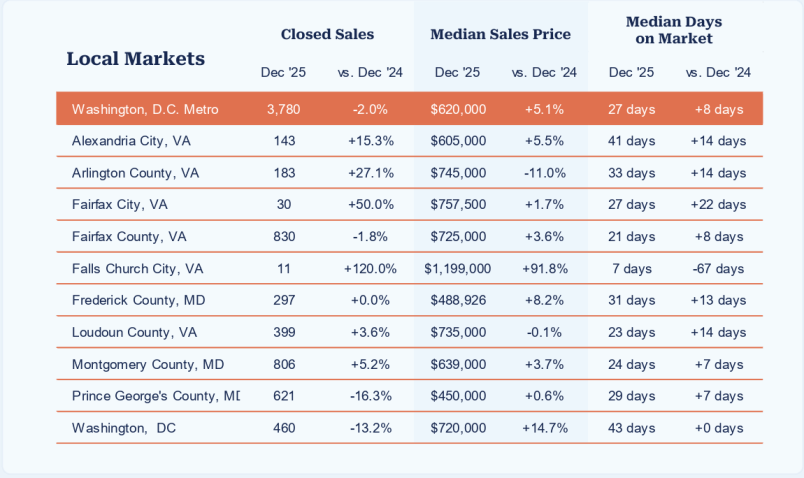
The December data from BrightMLS offers a reassuring close to the year across most of the Washington Metro region. Activity remains steady, prices appear to be resilient, and while days on market have stretched modestly, conditions continue to favor well-prepared buyers and sellers.
Northern Virginia and suburban Maryland performed particularly well. Alexandria, Arlington, Fairfax, Falls Church City, Loudoun, Montgomery, and Frederick Counties all showed solid to improving sales activity with generally stable or rising median prices. The increase in days on market across these areas reflects normalization rather than weakness. Buyers are deliberate, inspections matter, and pricing discipline is rewarded.
While median prices in D.C. rose year-over-year, closed sales declined and days on market remained elevated. This divergence is largely driven by the condominium sector, where rising condo fees, insurance costs, and buyer sensitivity to monthly carrying expenses continue to suppress demand. Well-located single-family homes and townhomes remain competitive.
This is not a distressed market at all. It is a discerning one and the panic to buy ‘something’ seems to have passed.
Homes that are priced correctly, are well-presented, and are aligned with buyer expectations are selling well. Those that are not, are waiting. Now, strategy, preparation, and thoughtful positioning matter more than ever.
Real estate decisions should always be made locally, not generically. The data reinforces what we, at Properties on the Potomac, Inc. see daily. Sales are driven by activity and not by headlines.
Do you have a low mortgage that you hate to give up? But you want a different living environment? Krasi Henkel has a plan for you. One that builds equity, wealth, and curates your lifestyle. Text Krasi – 703-624-8333
It is the Holiday Season again. Social calendars and children’s activities are at their peak. A common belief is that December is “quiet” in real estate. In reality, things are abuzz preparing for the New Year. Realtors are planning and wrapping up their year. Many homeowners are thinking, while perhaps, not taking immediate action.
When the calendar slows, distractions abound. Plans percolate. There might be fewer sales. There is also less competition (good for buyers). Are you evaluating how your space functions? Conversations often shift from “Should we?” to “What do we want next?” What do you really want?
The Conversations That Matter Most
Planning conversations revolve around timing, readiness, and sequencing. Much depends on selling or holding the current property. Should you consider a more immediate or deferred approach?
What matters to you most? Do you need more space, a different location, more land? What does your next chapter look like?
Here is why early planning matters. Several years ago, a client shared some plans for the following year. We discussed options and made a plan. I received a distress call shortly before their listing was going on the market. A neighbor was also going on the market at the same time. “What should we do?” I assured them that we are ready to put the house on the market immediately. There were no properties for sale in the entire community. So, “Let’s get you several offers, the best buyer, and the best offer, and those who miss your house can have the next one.” This is exactly what happened. Soon after their sale, three more houses came on the market. There were no multiple offers. Our price remained top for the neighborhood for quite some time.
Financial Considerations
The financial and strategic conversations are inescapable – the “yes…but.” Yet, where there is a will there is a way. You most likely have equity in your current property which will benefit your future purchase. As a seller, tax advantages could help you act sooner than later. Perhaps now is a good time to have a preliminary conversation with your trusted real estate advisor.
Your three percent loan is marvelous, but you can still up or downsize despite interest rate fluctuations. I have structured many happy outcomes and helped my clients build wealth.
Waiting until January or worse, “spring” limits your options. January brings speed, competition, and many external pressures. Making reactive decisions is rarely optimal. Early conversations allow for better evaluation, preparation, and ultimately, execution.
As in any important financial consideration, thoughtful outcomes begin with thoughtful conversations. If you are considering a potential change, contact me now. I will help you sort the pieces and give you meaningful information with which to make good decisions. After all, the best real estate decisions are rarely rushed. They are considered.
This is the season when we spend more time indoors and our doors and windows remain closed for longer periods.
I am deathly allergic and toxic to mold. A three second exposure can make me ill for weeks and even months. I often laugh with my buyer clients that I am the official “mold meter” when we look at houses. There have been times that I detected mold even before opening the front door. I share my experience with my clients, and we leave as quickly as possible. Sick houses can be cleaned. My clients need not be the ones to do that.
Not everyone smells or reacts to mold. I believe that educating my clients is paramount. No sale is worth illness and maladies. I would rather walk away than knowingly let my clients buy into malaise, illness, and even life-threatening accidents. A mold reaction caused me to fall from my horse, breaking my ankle. My life changed. I have not been the same ever since.
While everyone has varying levels of reaction, if any, to mold in a property, it is important to understand how mold develops and where it can grow. It is not always the old basement, although it quite possibly can be. With weather changes and moisture changes, below is a list (not comprehensive but suggestive) where mold can grow:
Window casings and drywall around them
Doors – under sill plates and around the frames on the drywall
Under sink base cabinets
Under dishwashers
Under washing machines
Under HVAC condensate lines
Inside HVAC air handlers
Behind and under refrigerators (even those without water sources)
Bathrooms
Basements – under floors, wall bases, even ceilings
Your car!!
What can you do to prevent mold from taking root in your home or car?
Inspect window caulking regularly – recaulk as needed
Check door sill plates – especially at decks and patios
Look under sinks – look for evidence of moisture – attack and remediate
Look under your dishwasher for evidence of water and mold signs
Look under and behind washing machines
Have your HVAC serviced and inspected semi-annually – ask your tech to look for evidence of leakage and mold
Pull your refrigerator out – inspect the floor
Run the exhaust fan in your bathrooms while showering to prevent condensation build-up
Confirm that bathroom exhaust fans are operating properly
Change the air filter in your car
Keep all HVAC filters clean
Here are a few unsettling facts that I recently discovered:
Drywall in its manufacturing process has imbedded mold spores
Mold loves drywall. That is why after a water incursion event, mold grows on drywall very quickly.
New home construction can “build-in” mold during the construction process by allowing materials to get wet.
Your car’s trunk gasket can be allowing water incursion and harboring mold
Your car’s air filter can get damaged by mice – their deposits can sprout mold
Your car’s AC can leak into your dash – mold can sprout
These lists are just a few of the mold issues that can develop over time or quickly.
Mold has been associated with chronic fatigue syndrome, headaches, upper respiratory ailments, even ‘colds’ could be reactions to mold. Do not be lulled into security by a ‘new house.’
Last year, I walked through our basement bedroom for a split second. That was long enough for me to get sick. It lasted through January. Where was the mold? Our basement bath exhaust fan had stopped exhausting but sounded to be running just fine. My husband likes the shower there. The moisture from the shower traveled to the far corner of the room, settled on the cold tile floor under a night table, and sprouted a quarter-sized spot of mold.
As a precaution – I had the exterior walls’ drywall removed – luckily – all was dry including studs and base framing. The tile was dry with no evidence of water. I called a waterproofing company – they tried to sell me a $50,000 remediation system.
I decided to call on the home inspector who inspects my clients’ home purchases. He came armed with a moisture meter. He found none. Then, he suggested laying down and sealing a vapor barrier plastic sheet like that of a crawl space. He told us to leave it down for 7-10 days. If at the end of the period, there was moisture under the barrier – there is a water problem. If none, then it was a condensation problem. Luckily, it was the latter.
Our brilliant contractor figured out that the exhaust fan was not extracting the condensation. In with a new fan and lots of cleaning – all is well.
However, this episode required that I discard the entire contents of the room. I had my brand new furnace thoroughly cleaned and disinfected. Mold spores are airborne and had certainly settled on all fabrics and furnishings. All because an exhaust fan had malfunctioned. On that note – ask questions about the history of any resale furnishings that you are considering buying. Have you ever smelled mustiness in antique drawers . . . ?
Mold is toxic and for those who are sensitive, each episode increases that sensitivity and the reactions. While I am not a mold expert, here is a link to mold and its remediation on YouTube. The mold conversation begins around the 3 minute mark. It is a little long but could save you years of misery.
If you have questions or need resources, contact Krasi Henkel – TEXT – 703-624-8333. If you are planning to buy your next home, Text Krasi.
The Update That Will Change Many Agents’ Clients’ Privacy
On November 15, Zillow’s new Follow Up Boss policy activates. It allows Zillow to analyze “mutual customer data” — information about people already stored in an agent’s database and active on Zillow. In practice, that means private notes, personal dates, communication records, and engagement metrics will most likely flow into Zillow’s broader system.
The Fine Print Behind the Automation
Agents and brokers across the country rely on Customer Relationship Management CRMs that promise efficiency. That speed has a price. By clicking “agree,” most have granted sweeping permissions that they have most likely not read. These updates are not breaches. They are contracts of consent written in language few real estate professionals have the time , patience, or legal acumen to interpret.
Why This Matters to You
Real estate is built on trust and confidentiality. When client data becomes “shared metadata,” trust erodes. The public assumes its conversations with agents are private. Agents assume that their CRMs act as secure tools. Both assumptions are now questionable.
Properties on the Potomac Does It Differently
At Properties on the Potomac, technology serves judgement. We never replace judgement with technology. Of course, we use advanced digital systems, but we maintain local control of all client data. No automated platform owns our client relationships, and no algorithm decides who receives correspondence.
Our data protocols are guided by three principles:
Control: We decide where our data lives, and who can access it.
Confidentiality: Your personal and financial information remains between you and your agent.
Accountability: We read ‘agreements’ before signing and occasionally forego convenience for privacy. Your trust is not a click-through box.
Krasi’s extensive education in accounting and finance has developed a “radar” to detect potential conflicts of interests. In 2002, when her then brokerage demanded that all client data be entered into their centralized CRM system, Krasi changed companies.
When asked which CRM our company uses, Krasi replies, “spreadsheets.” Why? Because our clients do not have to be “managed” with prewritten impersonal communication. Real Estate is still a PEOPLE business. The person who is helping you with your most important financial transaction must respect you more than AI-generated communication can offer.
The Bottom Line for You
Technology should enhance professionalism. Convenience is valuable, but not at the expense of control.
Technology must never erase human professionalism.
Nestled in Virginia’s northwest corner, Western Loudoun County represents one of the region’s most distinctive real estate markets. Properties here offer a captivating blend of agricultural heritage and contemporary country living, with investment opportunities ranging from historic estates to luxury new construction. Rolling hills dotted with stone fences frame breathtaking Blue Ridge Mountain vistas, creating premium viewsheds that significantly enhance property values.
Western Loudoun real estate includes luxury new builds……historic estates……and charming small towns.
The region’s thriving agribusiness sector supports strong agricultural property demand, from century-old family farms to boutique agricultural ventures. Over 45 award-winning wineries have established Western Loudoun as Virginia’s wine country epicenter, driving specialized vineyard property values. The robust equestrian market features everything from modest hobby farms to world-class training facilities, with proximity to riding trails and hunt country commanding premium pricing.
Western Loudoun proudly preserves its rich foxhunting tradition through prestigious hunt clubs like Loudoun Hunt and Middleburg Hunt. Properties within established hunt territories often enjoy enhanced market appeal and stronger value retention, particularly among equestrian buyers.
The area boasts a robust equestrian community……award-winning wineries……and a rich foxhunting tradition.
Families invest here for top-rated public schools and prestigious private academies. The real estate market benefits from exceptional recreational amenities, charming historic towns, and proximity to Washington DC, creating a perfect balance of rural tranquility and metropolitan access that continues to attract discerning buyers seeking authentic country living without compromise.
If you are considering quality of life and a upscale rural lifestyle, contact our broker, long-term resident, and equestrienne, Krasi Henkel at 703-624-8333, to discuss your goals and options.
Navigating Uncertainty: Real Estate at a Crossroads Never has the real estate landscape been so contradictory – simultaneously showing signs of strength and vulnerability. Are we facing a boom, a bubble, or an impending bust?
Properties on the Potomac’sKrasi Henkel has accurately predicted the last three real estate cycles from downturns to upswings. Her proven foresight is more valuable than ever in today’s complex market.
While technology floods us with information at unprecedented speeds, we mustn’t forget the human element of real estate – these are decisions about your most significant asset and potentially your largest liability.
Are We Heading for Another 2008? The question on everyone’s mind: Are we reliving 2007, with 2026 poised to mirror the 2008 collapse? Perhaps – but today’s landscape features critical differences:
Severe Housing Shortage: Virginia alone faces a deficit of 300,000-500,000 units
Historic Low Affordability: Homeownership remains out of reach for many
Improved Interest Rates: Creating new opportunities for strategic buyers
Record-High Prices: Pushing market elasticity to its limits
Building Market Pressure: Indicators point toward an inevitable correction
Make Decisions with Expertise, Not Algorithms Should you buy now? Is it time to sell? These questions demand more than automated valuation models and trending hashtags.
With firsthand experience navigating multiple real estate cycles, Krasi has developed a proprietary system to help Properties on the Potomac clients evaluate their options and craft intelligent, personalized strategies.
The bottom line: Don’t trust algorithms alone with your financial future. At Properties on the Potomac, Inc., our agents bring sophisticated understanding of real estate economics, finance, and equity evaluation to every client relationship.
Our singular mission is protecting our clients’ best interests during these uncertain times. For 2025, we have limited availability to welcome new clients. Don’t miss your window to explore your options with true market experts.
Krasi Henkel Transforms Lives Through Exceptional Real Estate Experiences and Services
In the world of real estate, true excellence goes far beyond transactions—it’s about creating transformative living experiences. “My journey is a testament to the power of perseverance, passion, and profound personal commitment,” says Krasi.
A Legacy of Determination
Krasi describes her early experience, “My real estate story began not in boardrooms or luxury open houses, but in a moment of childhood resilience. At just nine years old, I stood alongside my immigrant parents, challenging the status quo when faced with discriminatory housing practices. When we were told, ‘We don’t sell to people like you,’ I responded by asking what we needed to become to achieve our dreams.”
“The day we moved into our new home was more than a real estate transaction—it was a pivotal moment of hope, opportunity, and the American dream realized. Those early experiences taught me that a home is far more than brick and mortar; it’s a sanctuary where families grow, dreams take root, and futures are shaped,” reflects Krasi.
Leadership and Continuous Growth
As a testament to her industry standing, Krasi currently chairs the NVAR (Northern Virginia Association of Realtors) Small Broker Forum 2025. She is also one of just 25 members selected for the prestigious 2025 NVAR Leadership Institute. Her commitment to professional excellence includes earning a Certificate in Business Excellence from the College of William and Mary and a Master Certificate of Negotiation from Harvard Law School’s Program on Negotiation.
When not transforming the real estate experiences of her clients, Krasi enjoys life on her horse farm with husband Jon Henkel, who serves as Associate Broker at Properties on the Potomac, Inc. Together they share their home with four horses, four cats, and their beloved Bernedoodle, Sophie. Krasi’s passions include dressage riding, nature walks in her favorite parks, the arts, and writing insightful blogs about real estate, arts, and lifestyle.
Expertise Meets Empathy
With over three decades of professional real estate experience, Krasi brings a unique blend of market expertise and deep personal understanding to every client relationship.
“I don’t just help clients buy or sell properties; I help them curate lifestyle environments that reflect their deepest aspirations,” Krasi explains. “Whether seeking an urban retreat, a suburban community experience, an equestrian estate, or a strategic property investment, I guide clients to clearly identify their true desires before designing customized solutions.”
Having served thousands of clients with billions in real estate transactions, Krasi maintains an exceptional market intuition. She provides timely counsel on when to act decisively, when to pivot strategies, and when patience is the wisest approach. Her track record speaks for itself—she accurately predicted each market fluctuation since 1988 and their subsequent recoveries.
Curious about her current market insights? Contact Krasi for your personalized market report.
When it comes to selling your home, the kitchen remains the heart of the house and often the deal-maker or breaker. But finding the perfect balance between impactful updates and smart spending can be tricky. Let’s explore how to maximize your kitchen’s appeal without overspending or under-improving.
Butcher block counters offer a more modern look without breaking the bank.You can often update cabinets by simply painting and adding new hardware.Under-cabinet lighting can instantly transform your kitchen with a more high-end look.
The Smart Money Zones The most impactful kitchen updates often focus on three key areas:
1. Countertops: Granite is no longer the automatic go-to. Consider these mid-range options that offer both beauty and value:
Quartz composites: Offer durability and style without the maintenance of natural stone
Butcher block: Add warmth and character at a reasonable price point
High-end laminate: Modern options mimic stone so well that buyers often can’t tell the difference
2. Cabinetry: Full cabinet replacement isn’t always necessary. Consider these strategic updates:
Cabinet refacing: About 30-50% cheaper than replacement while providing a completely new look
Paint and hardware: A professional paint job and modern hardware can transform dated cabinets for under $5,000
Selective replacement: Replace only the most visible or damaged cabinets while refinishing others
3. Lighting: Good lighting can make even modest updates look high-end:
Under-cabinet LED strips: Create ambiance and functionality
Statement pendant lights: Draw the eye and add contemporary flair
Recessed lighting: Brighten dark corners and modernize the space
Classic subway tiles in neutral colors offer an upscale look at an affordable price.Replacing an outdated sink and faucet can instantly modernize the kitchen.Paint delivers the highest return on investment of any single kitchen update.
Cost-Effective High-Impact Updates 1. Backsplash: Choose classic subway tiles or geometric patterns in neutral colors. They’re affordable but look upscale when properly installed.
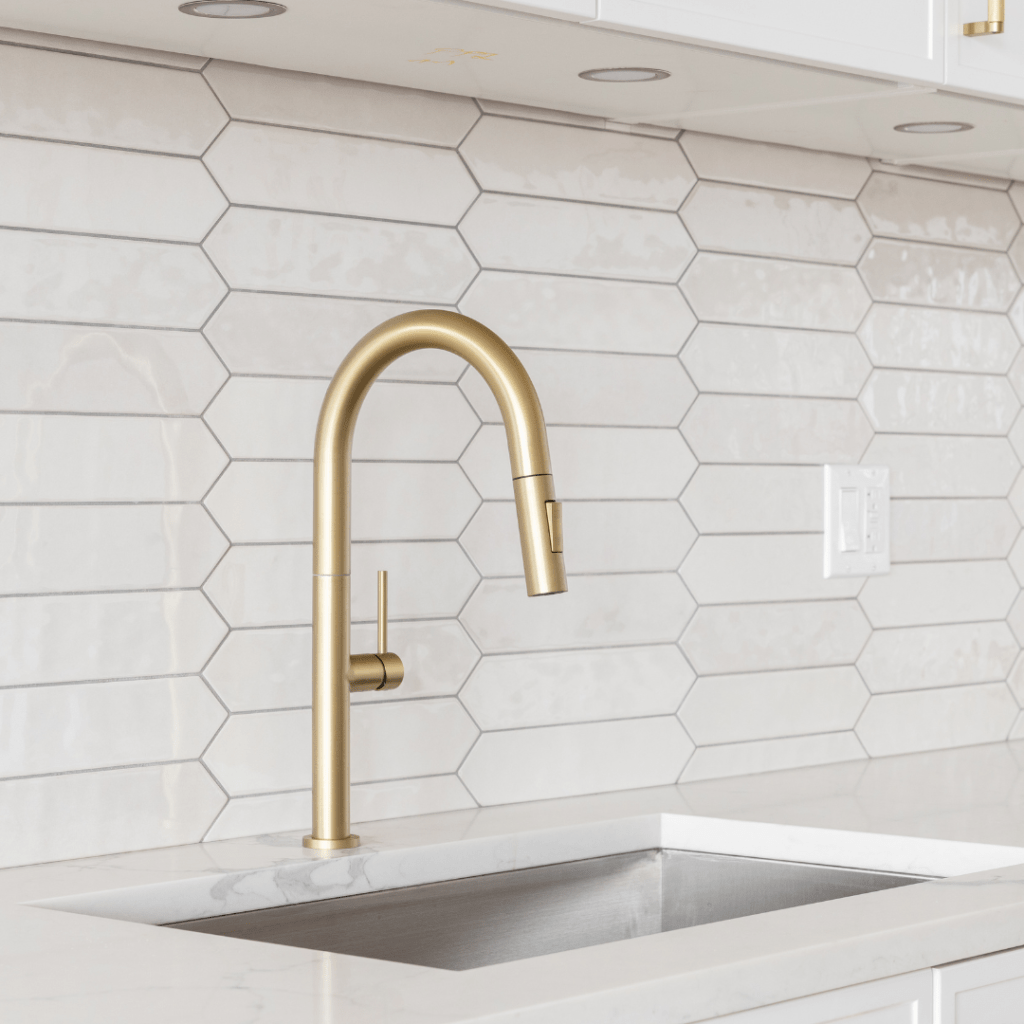
2. Sink and Faucet: A deep undermount sink and professional-style faucet can give the kitchen a high-end feel without breaking the bank.
3. Fresh Paint: Choose warm neutrals or soft whites to make the space feel clean and inviting. Paint delivers the highest return on investment of any single update.
Where to Save vs. Splurge Save On:
Appliances: Mid-range, matching appliances often provide better ROI than high-end models
Hardware: Shop retail sales for cabinet pulls and knobs
Flooring: Luxury vinyl plank offers durability and style at a fraction of hardwood’s cost
Splurge On:
Professional installation: Poor workmanship can devalue even expensive materials
Quality faucets: They’re frequently used and scrutinized by buyers
Lighting fixtures: They serve as jewelry for your kitchen
The Numbers That Matter Based on recent market data:
Minor kitchen remodel average cost: $23,452
Value recouped at sale: 77.6%
Sweet spot budget range: $15,000-30,000
Avoid Common Mistakes
Don’t over-customize: Keep updates neutral and broadly appealing
Skip trendy choices: They can quickly date your kitchen
Maintain proportion: Ensure updates match your home’s overall value 4. Consider your timeline: If selling within a year, focus on visual impact over durability
The Bottom Line The key to a successful kitchen update is understanding your market and your buyers. In most cases, you’ll see the best return by creating a fresh, modern look without going overboard on high-end finishes. Focus on clean lines, neutral colors, and quality materials in the mid-range price point.
Remember: The goal isn’t to create the most expensive kitchen on the block, but rather the most appealing one within a reasonable budget. This approach not only attracts buyers but also provides the best return on your investment.
Need help planning your kitchen update? Let’s talk about what makes sense for your home and market. Contact Krasi Henkel at 703-624-8333 today for a personalized consultation and market analysis.
In an era of algorithms and automated systems, real estate remains fundamentally about human connection. At Properties on the Potomac, we believe technology should enhance, not replace, personal service.
The Evolving Landscape of Real Estate Technology The Old Model: Shiny Tech Toys Once, agents competed by showcasing the newest technological tools. The agent with the most advanced gadgets often won client attention. But real estate is more than flashy interfaces—it’s about understanding, strategy, and genuine client care.
The Current Technological Ecosystem Today’s real estate technology looks like this:
Listings broadcast instantly across multiple platforms
Automated lead generation systems
Websites that redirect potential buyers to paying agents
Advanced marketing algorithms
The “Numbers Game” Approach Some top-producing agents now prioritize quantity over quality:
Automated calling systems
High-pressure scheduling
Transaction processing delegated to teams
Minimal personal interaction
The Hidden Cost of Impersonal Technology When technology replaces people, consumers lose:
Personal relationship with their original listing agent
Comprehensive property understanding
Tailored market insights
Genuine communication
What Clients Really Want
Personalized communication
Proactive market updates
Agents who understand their unique needs
Skilled negotiation
Comprehensive property marketing
Consumer Empowerment: Your Choice Matters You have the right to choose:
Personal service level
Marketing approach
Showing participants
Buyer qualification standards
Technology as a Tool, Not a Replacement At Properties on the Potomac, we use technology strategically:
To save clients time
Enhance communication
Provide market insights
Support, not supplant, personal service
Our Commitment: Humanity First We leverage technology to:
Streamline processes
Provide transparency
Support client goals
Maintain personal connections
The Real Value Proposition In a market obsessed with speed, we focus on:
Quality over quantity
Relationship building
Thorough offer evaluation
Client-centric approach
A Final Thought Technology can list a property, but only humans can truly understand a home’s story.
Ready to experience real estate with a human touch? Contact Properties on the Potomac, where technology meets genuine care. We’re not just selling properties—we’re helping you write your next life chapter.
Contact Broker, Krasi Henkel at 703-624-8333 (text for quickest response) and visit our website: http://www.POTPHOMES.com
The landscape of generational wealth transfer is undergoing a massive shift. Over the next two decades, baby boomers and the Silent Generation are set to pass down an astounding $84.4 trillion in assets, including real estate, financial instruments, personal property, and even pets and livestock. As a seasoned real estate professional, I’ve witnessed firsthand how this inheritance process can become an overwhelming and emotionally charged journey for many families.
The Inheritance Roadmap: Navigating with Wisdom and Care Here are five critical considerations when navigating an inheritance:
1. Open Family Communication: The foundation of a smooth inheritance process is transparent, honest communication. Initiate conversations about estate intentions early:
Locate and review important documents
Identify the designated estate administrator
Discuss the location of wills and trusts
Understand the family attorney’s contact information
Uncover details about potentially valuable collections (art, antiques, coins)
2. Sibling Harmony: When multiple heirs are involved, expectations management is crucial:
Have candid discussions about the inheritance
Set realistic expectations
Create a framework that prevents potential conflicts
Prioritize family relationships over material possessions
3. Objective Property Assessment: Approach personal property and inheritance with both sentiment and practicality:
Carefully evaluate what items truly hold value for you
Consider sentimental attachments objectively
Be willing to let go of items that don’t serve a purpose
Respect the memories associated with belongings without being overwhelmed
Establish a relationship with estate auctioneer(s)
4. Real Estate Strategy: Develop a comprehensive plan for inherited property:
Create a timeline for property assessment
Determine whether to sell or maintain the property
Budget for potential improvements or repairs
Consult real estate professionals for market insights
5. Tax and Legal Preparedness: Understanding the legal and financial implications is critical:
Consult with a tax professional
Learn about inheritance tax laws
Understand potential tax implications
Develop a strategy to minimize tax burden
Here are five critical pitfalls to avoid when navigating an inheritance:
1. Hasty Storage Solutions: Resist the urge to quickly box everything and store it away. This approach:
Leads to unnecessary expense
Creates logistical complications
Prevents proper sorting and decision-making
2. Home Clutter Accumulation: Avoid filling your personal space with inherited belongings:
Prevents home organization
Creates unnecessary stress
Delays necessary decision-making
3. Overreliance on Verbal Valuations: Never take valuations at face value:
Consult multiple experts
Get professional appraisals
Verify the true worth of items
4. Family Conflict: Prioritize relationships over possessions:
Communicate openly and compassionately
Be willing to compromise
Focus on maintaining family bonds
5. Procrastination: Time is of the essence:
Make decisions promptly
Address legal and financial matters quickly
Prevent complications from delaying action
Emotional Perspective: Honoring Memories
Inheriting a household is more than a financial transaction—it’s an emotional journey. Remember that your loved ones cherished these belongings, but memories persist beyond physical objects. Be kind to yourself and your family during this process.
Key takeaway: Things have no permanence. Some items are meant to be memories, not permanent possessions. Embrace the opportunity to honor your family’s legacy while creating your own path forward.
By approaching inheritance with preparation, compassion, and strategic thinking, you can transform a potentially stressful situation into a meaningful transition that honors your family’s memory and your own future.
Are you or someone you know stressing about what to do with inherited real estate? Reach out to Properties on the Potomac at 703-624-8333 today!