By Krasi Henkel

As opinions have currency in real estate, the cultured credibility offered by a home library can sway buyers and add significant value to a house. Though e-readers and digital books are common, there remains strong appeal to the tangible permanence and character of print books lining built-in shelves.

More than a storage place for novels and non-fiction, the home library represents intellectualism and refined tastes which many affluent buyers seek in a residence. Beyond superficial decor, an elegant library signals the substance of both current and past owners. It communicates that interesting dinner conversations, music, and art have filled those rooms.

Built-in bookcases hold special weight over stand-alone shelving. They demonstrate forethought in the home’s original design and construction and cannot be easily moved or changed on impulse like furniture. As integral house features, custom built-in bookcases can add 10-15% of their initial cost to listing prices. Their fixed nature also means volumes collected over years remain on display.

The permanence, personalization, and intellectual substance embodied in a home library comprises a unique asset. For buyers seeking both image and lifestyle, rooms of books can add eight to fifteen percent in perceived worth…or perhaps prove literally priceless among competing listings.

In showcasing owners’ sophistication, libraries reveal character that cannot be fabricated. Where furniture and paint colors change on trends, libraries accumulate over lifetimes. They bestow cultured credibility more reliable than passing fashions. For buyers sharing such values, a house with a library makes tangible the intellectual and cultural traditions they wish to perpetuate.


If you’re in search of a home with a library, or perhaps a home with the perfect space to build the library of your dreams, we’re here to help! Call Properties on the Potomac at 703-624-8333 today.

“How is the market?”

This is our most frequently asked question. It is understandable given low inventory, rising interest rates, and homes often selling for over list price. Real estate headlines can seem daunting. Headlines notwithstanding, our market is still active. Home values climbed at about 3.5% in the first half of this year as demand continues to outpace supply.

The key to this market is being an educated buyer or seller. Now more than ever, working with the right agent is critical. Selecting a savvy, experienced agent who will give you expert guidance will make all the difference in this competitive market.

Our proven systems help our clients find the right homes and make the best offers. Our success speaks for itself. We leave no details to chance. Our sellers optimize their properties to attract the most qualified buyers who are ready to move quickly.

Today’s most successful real estate agents are taking advance reservations from qualified clients. By planning ahead and partnering with a top agent, buyers and sellers can still achieve their property goals, even in this fast-paced market.

Bottom line: real estate remains an essential need and purchases are happening every day. With the right preparation and guidance, your real estate goals can absolutely become reality. The key to our clients’ success are our well-honed systems.

Do you have real estate plans for 2024? Connect with Properties on the Potomac at 703-624-8333 to start strategizing for your next move!

The aspiration of homeownership, often regarded as a key driver of wealth for many Americans, faces significant hurdles in the current real estate landscape. The housing market has evolved into a complex arena, particularly for first-time home buyers. This blog post delves into the challenges encountered by these buyers, exploring factors such as high interest rates and soaring property prices that are reshaping the journey toward owning a home.

First-Time Home Buyers at a Crossroads
As economic conditions shift, those looking to purchase their first homes have found themselves facing slow economic growth since entering the workforce. Coupled with student loan debt and childcare expenses, their path to homeownership has been far from smooth. Rising interest rates and elevated property prices have further compounded their challenges, influencing their purchasing power and timelines. As a result, the median age of first-time home buyers has risen to 36, marking a departure from historical trends.

The Struggle for First-Time Buyers
The housing market’s changing landscape is evident from the numbers. Federal Reserve data indicates a 26% increase in median home prices since early 2020, with average prices reaching $416,100 nationally. This surge is particularly noticeable in the Northeast and the West. Meanwhile, the average 30-year, fixed-rate mortgage is currently hovering around 7%, nearly triple the rate recorded in 2021!

Navigating Uncertainty
First-time home buyers, regardless of their generational labels, find themselves at a crossroads due to the unpredictability of interest rates and property values. The adage “marry the house, date the rate” has gained popularity, suggesting that buyers secure a property and consider refinancing later when rates drop. However, experts caution that this approach comes with inherent risks and complexities. Refinancing entails costs that need to be balanced against potential savings from lower rates.

Planning for the Future
For those contemplating their first home purchase, the dilemma of whether to buy now or await changes in rates and prices is a significant consideration. Amidst the prevailing uncertainty, experts advise careful planning and preparation. Acknowledging the reality of high interest rates and planning for them is a prudent strategy. The historical pattern of fluctuating rates underscores the importance of making decisions aligned with long-term financial objectives, rather than attempting to time the market. If you wait until rates drop, we will see a surge of homebuyers flooding back into the market, raising prices further.

The evolving housing market presents a challenging landscape for first-time home buyers with dreams of owning their own homes. Despite the hurdles, first-time home buyers persist in their pursuit of a place to call their own, working to reshape the American dream for their generation.

At Properties on the Potomac, we understand the unique challenges that first-time home buyers face in today’s dynamic market. Our dedicated team of professionals has a proven track record of successfully guiding clients through these complexities to find the right property for them. With a deep understanding of market trends, interest rate fluctuations, and financial planning, we provide personalized solutions tailored to each client’s needs. Our commitment to empowering first-time home buyers sets us apart, as we strive to make the journey to homeownership a rewarding and fulfilling experience. Give us a call at 703-624-8333 today–with our expertise by your side, you can confidently navigate this intricate market and secure a place to call your own.

In the world of investing, there is a prevalent temptation to try to time the market, to predict its ups and downs with precision. Many people believe that by jumping in and out of the market at the right moments, they can maximize their returns and avoid losses. However, history and the wisdom of seasoned investors and real estate professionals…cough, cough, your favorite Properties on the Potomac agent… have repeatedly shown that timing the market is an exercise in futility. Let’s shed some light on the fallacy of market timing and highlight the benefits of a strategic long-term approach to real estate.

1. The Myth of Perfect Timing:
Timing the real estate market involves predicting when to enter or exit the market with the expectation of making significant gains. Unfortunately, accurately predicting short-term fluctuations in the housing market is a daunting task. Real estate markets are influenced by numerous factors, such as economic conditions, interest rates, supply and demand, and local factors, making it nearly impossible to consistently time the market successfully.

2. Emotional Pitfalls and FOMO (fear of missing out):
Attempting to time the real estate market often leads to emotional decision-making, driven by the fear of missing out on potential profits. Buyers may rush into purchasing a home during a market upswing, fearing that prices will rise further, potentially overpaying for a property. On the other hand, sellers may hold onto their homes during a market downturn, hoping for prices to rebound, potentially missing out on better opportunities. Emotions can cloud judgment and lead to poor real estate decisions.

3. Long-Term Market Trends and Cycles:
Real estate markets are subject to cyclical patterns and long-term trends. While short-term fluctuations may occur, over the long term, real estate has historically shown overall growth. Instead of trying to time the market, buyers and sellers can benefit from understanding these broader trends and making informed decisions based on their individual circumstances and goals. A strategic long-term approach allows individuals to navigate the market cycles with greater stability and confidence.

4. Financial Considerations and Transaction Costs:
Timing the real estate market often involves frequent buying and selling, which comes with financial implications. Costs such as real estate agent commissions, closing costs, and potential capital gains taxes can eat into potential profits. Moreover, attempting to time the market may lead to hasty decisions, resulting in undesirable outcomes or the need for costly corrective actions. A long-term approach to real estate transactions minimizes unnecessary expenses and maximizes financial gains.

5. Location and Individual Circumstances:
The value of real estate is heavily influenced by location and individual circumstances. Factors such as job opportunities, local amenities, infrastructure development, and demographic shifts can significantly impact property values. Rather than focusing on market timing, individuals should prioritize thorough research and analysis of the local market conditions, as well as their own specific needs and financial situation. Making informed decisions based on these factors is more likely to yield favorable outcomes.

Timing the real estate market requires careful consideration and a comprehensive understanding of various factors. Don’t let the allure of market timing lead to unnecessary risks and missed opportunities. Instead, take a proactive approach by reaching out to our team of experienced real estate professionals.

Properties on the Potomac can provide valuable insights, personalized guidance, and assist you in making informed decisions tailored to your unique needs. Contact us at 703-624-8333 today to start your journey towards successful real estate transactions.

In recent years, smart home technology has become increasingly popular, offering homeowners greater control and convenience over their living spaces. From security systems to smart lighting, there are a variety of devices available to turn any home into a smart home. And, with real estate in mind, today’s buyers appreciate the added value of a smart home already installed for them. If you’re interested in making your home a smart home, read on…

Start with a smart hub
The first step in making your home a smart home is to invest in a smart hub. A smart hub is a device that connects to all your smart devices, allowing you to control them from a single app. There are several popular smart hubs on the market, including Amazon Echo, Google Home, and Apple HomeKit. Once you have a smart hub in place, you can begin adding other smart devices to your home.

Add smart lighting
One of the easiest ways to make your home a smart home is to add smart lighting. Smart light bulbs can be controlled from your smartphone, allowing you to turn them on and off, dim them, and even change their color. You can also set schedules for your lights to turn on and off automatically, making it look like someone is home even when you’re away. Lighting options include Philips Hue, LIFX, and TP-Link Kasa.

Install a smart thermostat
A smart thermostat is a smart home device that can save you money on your energy bills. Smart thermostats can learn your habits and adjust the temperature of your home accordingly. They can also be controlled remotely from your smartphone, allowing you to adjust the temperature even when you’re away from home. Thermostat options include Nest, Ecobee, and Honeywell.

Consider smart security
Smart security devices can give you greater peace of mind by allowing you to monitor your home from anywhere. Smart security cameras can be accessed from your smartphone, allowing you to check in on your home at any time. You can also receive alerts if the camera detects motion or sound. Other smart security devices include smart locks, which allow you to lock and unlock your doors remotely, and smart doorbells, which allow you to see and talk to anyone who comes to your door. Smart security options include Ring, Arlo, and August.

Add smart entertainment
Finally, you can make your home a smart home by adding smart entertainment devices. Smart TVs can be controlled from your smartphone, allowing you to change channels, adjust the volume, and even launch apps. You can also add a smart speaker, such as the Amazon Echo, Sonos, or Google Home, to stream music, podcasts, and audiobooks throughout your home.

Making your home a smart home can be a fun and rewarding experience. By adding smart devices, you can make your home more convenient, secure, and energy-efficient. Whether you’re looking to add smart lighting, a smart thermostat, or smart security devices, there are plenty of options available to suit your needs and budget.

Want more tips and tricks for upgrading your home and/or making it more valuable for homebuyers? Give Properties on the Potomac a call at 703-624-8333.

While scam artists have always been around, modern technology has made their work easier and more effective. Readily accessible public records are fodder for them.

Recently, I received a text with the look and feel of an authentic inquiry. The writer inquired about commissions and timing. When I called the writer, he answered the phone. Our dialogue was typical of a potential seller. They responded with an Outlook email address to my request for their email address. The property address and description matched as well as the name given during our conversation.

The potential “seller” knew about the property’s features, details, and general acquisition information. My intuition had an initial twinge when I learned that the caller was out of town and wanted to sell as soon as possible. My scam antennae were on mild alert. I was planning identity verification measures before concluding the initial conversation.

The property in question was a vacant lot of substantial value. Fortunately, I am familiar with the area and the associated lots. My former investigator self was devising plans to verify the veracity of the caller.

Upon my return to my office, I dug deeper into the owner. I discovered phone numbers that did not match the one from which the text was sent. A phone call to the newly discovered phone number confirmed my suspicions. The caller/texter was a scam. The actual property owner confirmed that they had not spoken to me or asked to sell their lot. The owner was naturally upset. Was he being targeted, was someone trying to steal the lot, or was the texter trying to “tunnel” into my computer network?

How can someone other than the actual owner sell a property? There are many ways. One of the easiest ways is a gullible agent. Forged documents, identity theft, an absentee owner, an owner’s death, and many other scenarios can separate a rightful owner from their property.

What can a property owner do to protect the titles to their properties? Here are some ways:

  • If closing on a new purchase, buy owner’s title insurance. However, enhanced title insurance is typically not available for vacant land.
  • Another option is to subscribe to an identity protection service with a title monitoring option.
  • If you own investment property or vacant land, visit your properties, introduce yourself to the neighbors and ask them to alert you to any suspicious activities or strange or repeated visitors, visits or unexpected surveys.

At Properties on the Potomac, Inc., we are implementing new and higher levels of security to safeguard our community from this form of theft. We are educating our agents, working with professionals, and designing stringent security measures. The increased security measures might seem invasive to callers to our office and agents. Please know that we intend to protect property owners’ rights and never be duped to the contrary.

Through our affiliation with the National Association of Realtors, Northern Virginia Association of Realtors, and the Greater Capital Area Association of Realtors, we have available sophisticated resources and research tools with which we can help protect our clients and our community. If you have questions or concerns about real estate scams, call Properties on the Potomac at 703-624-8333.

The facts indicate that there is a market shift in progress. Higher interest rates with minimal inventory is spurring some sellers to remain aggressive when pricing their homes for sale. Last year at this time, some listings were selling for as much as 33% over their list prices. However, interest rates were in the low 3% range. In the end, it is about what buyers can afford to pay in a monthly payment.

The active homes (for sale) inventory across our region is at historic lows. The current Washington, D.C. Metro inventory is between a 30-60 day (depending on location) supply based on last week’s contract activities.

My market analysis disclosed that the active to under contract prices show a dramatic price disparity of 15% to 60% (location based) higher than the average prices of the properties that went under contract. Accordingly, the average days on the market for the active properties is also 33-57 days longer (about 66%) than the under contract properties.

In our recently wild market, it was impossible to underprice a property because it would get bid up to above its market value. Therefore, the real estate agent’s role was that of order taker and contract dissector. That condition has now changed. Now, the experienced, knowledgeable agent will analyze the market’s activity, study recent comparable sales, and recommend the best pricing for your property to get is sold as quickly as possible because that is when the optimal price will be received.

Under today’s changing circumstances, we often hear, “If they don’t like our price, they can make us an offer.” The reality is that they will not make an offer and will buy another property that they deem better priced. Buyers do not want to get too creative or too aggressive. They do not want to enter into negotiations that could end badly while losing better opportunities.

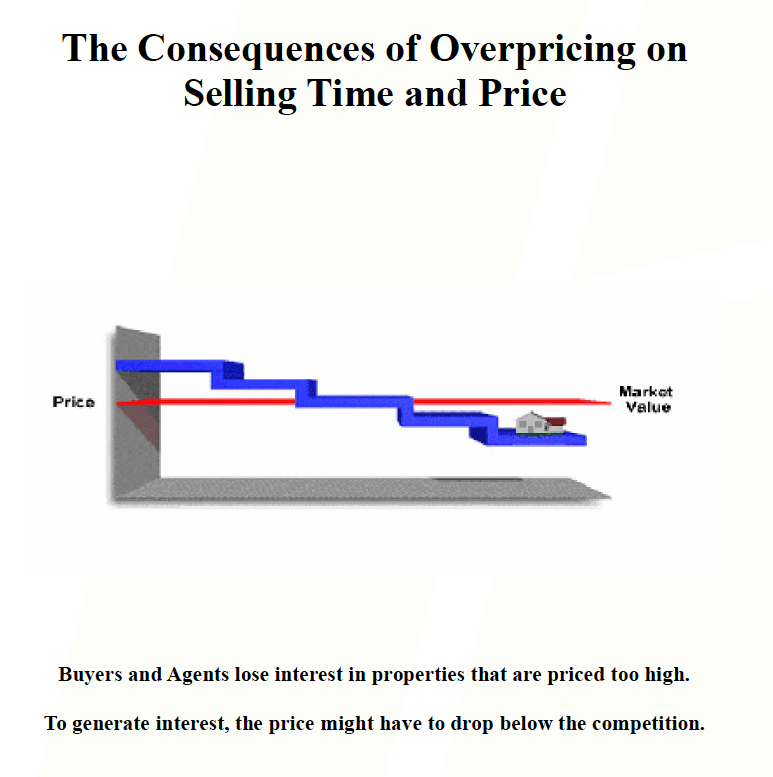
In any market, an overpriced property will languish. In fact, not only will the property languish, but it will ultimately sell for below market value. The chart below shows how the initial price affects the sales price. You can see the importance of pricing the property correctly from the outset.

If a property is overpriced by five percent, it is not unusual to have a final sales price of 3%-5% below actual market value. Why give up value on the gamble that a buyer will overpay in today’s market?

In our industry, the saying goes, “The first offer is usually the best offer.” The first offer typically comes in quickly with a good price and strong terms. Missing out on that first offer will diminish the seller’s ultimate return.

How is market value determined? The skilled, experienced, and knowledgeable real estate agent knows their market, their buyers’ expectations, and is well connected with the top agents in the area. Their wealth of knowledge and experience will help you make the correct pricing decision.

The bottom line: properties that are priced in line with buyer affordability are selling quickly. Properties pushing prices beyond market values are staying on the market.

Are prices falling? No. Many homes are being priced incorrectly and need reductions to bring them in line with actual market values.

If you are thinking about selling your property this year, do yourself a favor and call one of our exceptional agents for a market analysis at 703-624-8333. You will know that the price you set on your property will be competitive, thus bringing you the best returns.

Touring a new home subdivision with beautifully decorated model homes is exciting. Walking a vacant lot and imagining your home built on it is exhilarating. Not having to overbid, or hold your breath if your offer is accepted on a resale house can make the home-buying experience less stressful.

With low housing resale inventory, many buyers are turning to builders of new homes. But between falling in love with that magnificent model home and signing a contract, buyers should know these eight critical things:

  1. Research the builder’s reputation.
    Is this a builder who has a good reputation of delivering homes to many satisfied buyers? How are their reviews? Are there any lawsuits pending against them? 

  2. Does the neighborhood have an HOA?
    Is the house you are considering located in an existing HOA or Condo Association or will it be a brand new HOA? Who controls the HOA? Often the builder controls it until all lots are sold. Be sure to get a copy of the HOA/Condo Documents and review them carefully. Most jurisdictions provide for contract rescission within 3-5 days if for any reason the documents are unacceptable to the buyer.

  3. Understand the purpose of the deposit.
    While an earnest money deposit is made with a resale purchase contract, not all new home contracts take an “earnest money deposit.” Builders take a deposit. Some builders do not consider it an earnest money deposit, but a direct deposit toward the construction of the house, therefore it will be deposited in the builder’s operating account rather than in an escrow account.

  4. Are incentives offered by the builder?
    In certain situations, builders will offer free upgrades and/or closing cost assistance to the buyer. Be sure that you understand exactly what is being offered and that it is in writing with the exact terms represented by the builder’s representative. As in all real estate agreements, to be enforceable, terms, conditions, and promises must be in writing.

  5. What does the buyer have to do to qualify for those incentives?
    “Free recreation room” or “$10,000 in closing costs” or “Free Kitchen Upgrade” and many more iterations can be offered. Upgrades and closing costs are certainly appealing. What will be required of the buyer to qualify for the incentive(s)?

    Will the builder insist that the buyer finance with their lender and/or their title company? What is the actual cost of that requirement? Sometimes, the actual “cost” of the incentives exceed the benefit of the incentive. It is important to understand all costs and fees.

  6. What warranties and post-settlement services are included?
    In Virginia, a builder must warranty their construction for 12 months after settlement. Many builders offer 10 year warranties, 2-10 warranties, and/or pass on equipment warranties. All warranties are not the same. One question to ask is whether drywall imperfections post-closing are covered. Some builders will only correct drywall imperfections identified during the pre-settlement walk-through. Others will warrant drywall for extended periods.

    Will a list of the trades be available for ease of service, or must repairs/service be channeled through a central division of the builder? Is there a response timeframe? Be sure that all warranty questions are answered and verified in writing.

  7. Review the contract…then review it again.
    The builder’s contract has been written by their attorneys to be in their favor. Aside from contingencies specifically written into the contract, once the contract has been signed by all parties, it is an enforceable contract. The buyer should expect that they will settle on the sale. Before signing the contract, be sure that all terms are written as represented, all questions have been answered, and that you are prepared to move forward with the project. Know when (if) additional deposit(s) are due. Be prepared to attend inspections and builder meetings when they are called. While most builders want to be flexible, to be able to deliver a new home, schedules must be respected. Be sure to leave the contract signing meeting with a complete contract including all schedules and selections (to that point – more will be needed later).

  8. The model home decoration, appointments, & upgrades are for display purposes only.
    Your new house will come with plain walls, no window coverings, tiny landscape plants, and grass that you will have to water to establish.

    Depending on the builder, design choices can be included in the contract price. Design options can include flooring, shade/blinds, appliance upgrades, tile, counters and cabinets, faucets, sinks, lighting, and other options as available.

With many choices, state of the art equipment, and everything bright and shiny, it is easy to begin to believe that each option is indispensable. Be careful to keep within your budget and your lender qualification. Once options are selected and ordered, making changes can become very costly.

Contracting for a home to be built can be exciting and rewarding, and can result in the house of your dreams. Done incorrectly, the process can become a nightmare. It is for the above and countless other reasons that having an experienced Realtor representing your interests can save you money and sanity.

At Properties on the Potomac, Inc. we have been helping our clients select and design beautiful new homes for more than 35 years. We know the builders, the lenders, the incentives, the warranties, and most builders’ process. We know where to look and the questions to ask.

Is a newly built house in your future? Take the first step and give us a call: 703-624-8333.

“We plan to list in spring.”

Most people believe that selling their homes in spring (after March 21) is the best time. However, that is not real estate’s “spring” market.

Real Estate in no longer just regional, but national and even global. What happens in one area affects many others. Our properties in the Washington, D.C. Metro area are affected accordingly. Making decisions that affect one of your largest assets must be made with all of the best possible information. With this in mind, below are the five reasons to consider listing your property for sale now:

  1. We are not in last year’s market. There are no guarantees of unlimited buyers.
  2. The economy and corresponding interest rates are volatile.  
  3. In our decades of professional experience, the BEST time to sell is January, February, and March.
  4. Buyers have been planning their moves before the holidays and purchase after the holidays.
  5. Because most people count on the later market, the serious buyers have already made their decisions and purchased; leaving the inventory of listings to increase while the pool of buyers declines.

An example is from the post-2007 recession market: a client was being relocated to another state. They had to sell their home. We recommended listing it in February. After completing their presale activities, we put the house on the market in February. The first three groups who toured the house made competitive offers. Our clients made their move according to their best plans. Several months later, their neighbors listed their house for sale. Their house remained on the market for considerably longer than our clients’ property; selling with a single offer for slightly below my clients’ price.

In volatile markets such as this, delays can be costly.

If you are planning to sell your property this year, please contact us today so that we can help you make your best plans. Call or text us at 703-624-8333.

Here we are – the beginning of 2023 ! You have been waiting to make decisions and commitments until the holidays are over. Now what?

If you are thinking of moving – up, down, around, or away – here are a few tips to help you structure your activities:

  • Decided whether you want to sell or keep your current real estate. Either way, consult a competent real estate broker. The possibilities are endless and your investment and risk are huge. Be selfish and work with the best (that would be us – read our website and see for yourself).
  • If you plan to sell, list long before you want to go on the market. That way pre-marketing excitement can bring the best buyer.
  • Go through all the nooks and crannies of your home (that includes closest that you often use). Start with all off-season belongings first. Decide whether you will keep, toss, or donate.
  • If you have a home of 2000+ Square Feet, know that it will take you several weeks to complete the culling and packing.
  • Be smart and not impulsive. There are many garments and things, that due to the current circumstances ,have remained unworn or unused. Do not throw away anything on a whim. It doesn’t matter if it makes you happy if you will need it later. You will buy it back for more money and of lesser quality. Keep your stuff. Your happiness will compound with lower bills. Be a good steward.
  • Do not make capital investments in your current home unless it will be a coat of paint and some flooring. Keep it simple. Do not replace appliances with stainless steel.
  • Chose a smart real estate agent who knows what sells and what brings in the most return for your investment. – Again, that would be us – not bragging, just the facts.
  • In 2022, our listings sold for 105% of list price and our buyers paid 95.5% of list price. How is that? Ask us.
  • We’ll be happy to show you how you can benefit from our 35 years of experience in all sorts of markets.

Looking to make a move in 2023? Give Properties on the Potomac a call at 703-624-8333!